How to Get Faster at the Mini Crossword — Expert Tips from a Top-Ten NYT Constructor
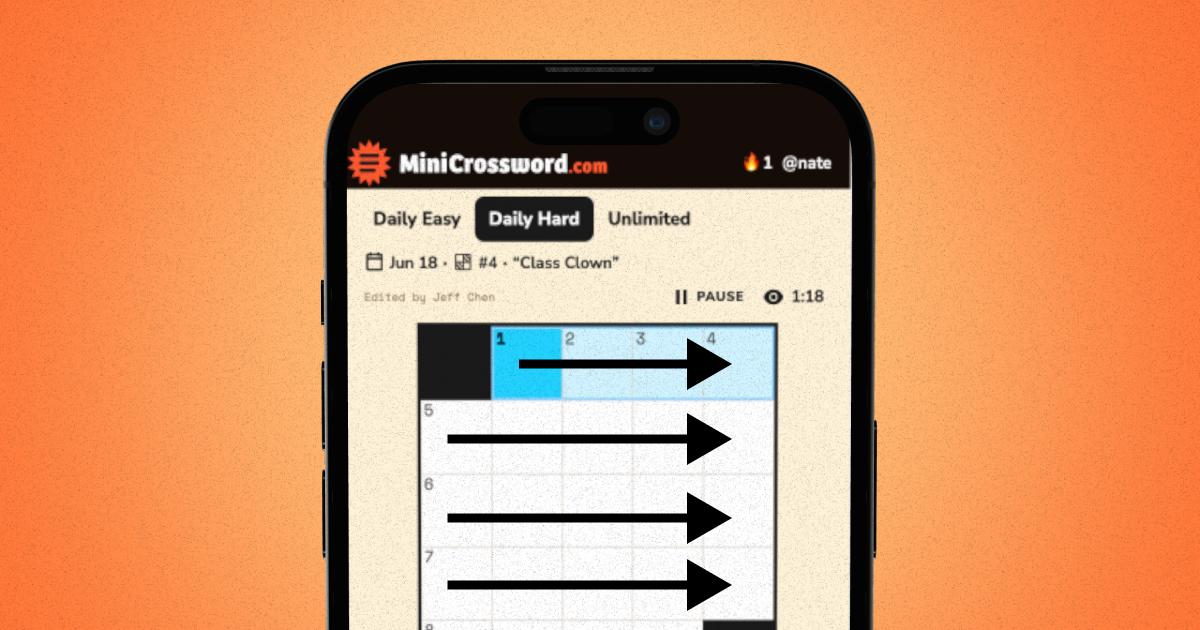
I've made 160+ crossword puzzles for the New York Times, and hundreds more for other venues, but I'm still a relatively slow solver. My wife, on the other hand, is a mini-crossword speed demon. How did she get to the point that she can solve some in under ten seconds? It seems miraculous, yet it turns out that anyone can achieve speeds high enough to taunt their dull-witted husbands!
Here are the secrets:
Don't Get Hung Up at 1-Across
If you don't immediately know the answer to 1-Across, don't waste valuable time trying to puzzle it out. Instead, move to the next clue! The hardest part about crosswords is getting started. Which brings us to ...
Scan Through the Clues to Find a Gimme
Most mini-crosswords will have some clue that is totally obvious to you, but the odds are that it'll be buried somewhere in the middle. [Opposite of up] has to be DOWN. [Vehicle that you might fill up with gas] is CAR. Once you have one answer in place, the solving process accelerates.
Switch Between Across and Down — Frequently
The best speed solvers can amazingly finish a full mini without looking at the Down clues. That's not me! Chances are, it's not you, either. The best strategy for us regular folk is to fill in an Across, then see if those letters help you with the Down answers. They usually do!
Look for Friendly Letter Patterns
Filled in a couple of letters, and you see something like TM___? Chances are you have something incorrect! Patterns like TE___ or AM___ look so much better. Here's a little insider secret to making crosswords: words that alternate between vowels and consonants make construction easier, so look for those patterns.
Think Like a Crossword Maker
It's not easy to fit so many words criss-crossing each other, so we constructors rely on common "Wheel of Fortune" letters like R S T L N E. It's much harder to use less common letters like J Q X Z, so you won't see them as much.
Let's Go Through an Example!
In this mini, the 1-Across clue is "Capital of Peru" and you're making your poor, old geography teacher wring his hands:
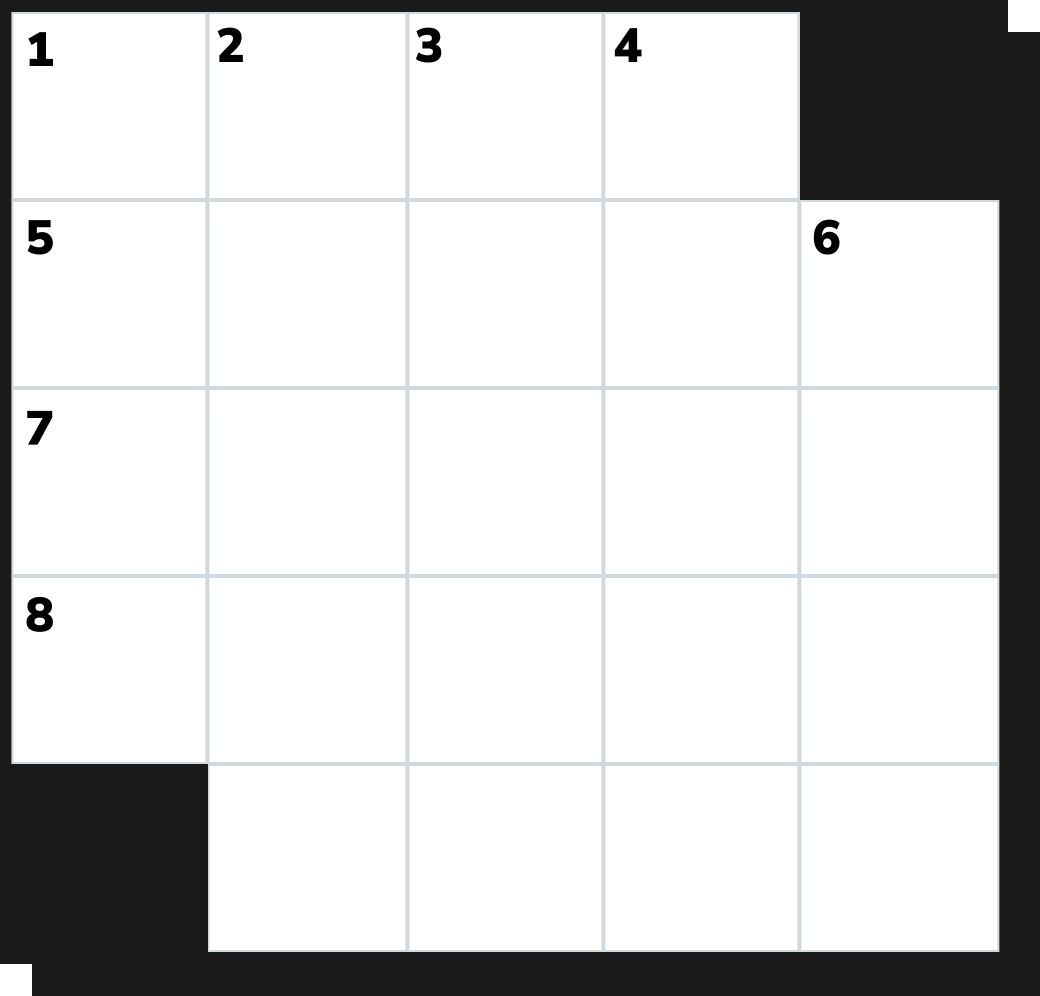
Instead of forcing it, you switch to 1-Down, [Disney movie "___ and the Tramp"], and 2-Down [They're shown as light bulbs in comic strips]. It isn't long before you figure out LADY and IDEAS.
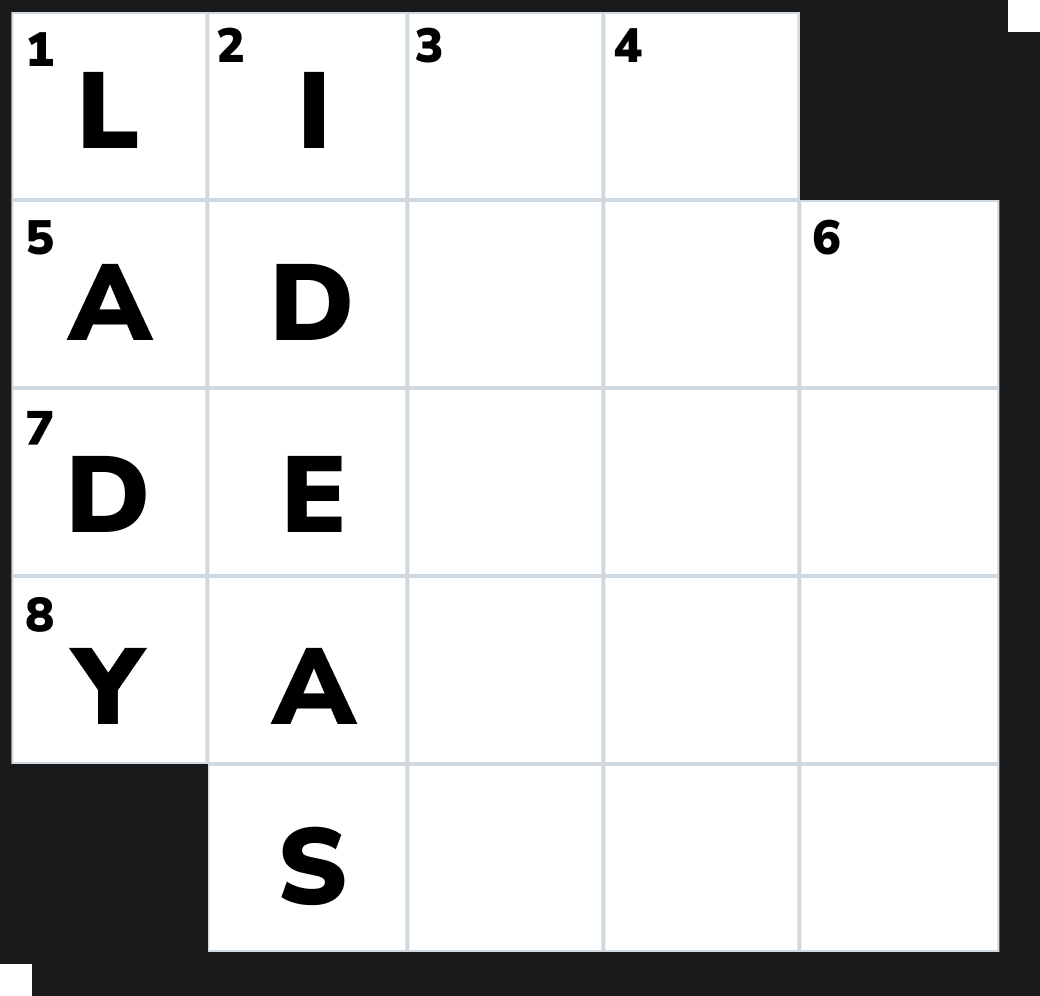
Notice how the beginnings of each row look like a real word? Look at all that vowel-consonant alternation, too!
Now, 1-Across reads LI__. Your brain fills LIMA before you've consciously recalled it. You barely even learned it because you were too busy scrolling Insta in geography class, but the crossings solved it for you!
Learn the Recycled Vocabulary
Crosswords rely on short, vowel-heavy words that show up in grids far more than in real life. These three- and four-letter words with friendly letter patterns are a finite set, and constructors reach for the same reliable fill over and over.
For example:
👉 ALOE — the "soothing gel" or "burn plant"
👉 ERIE — the "Great Lake" with the convenient vowels
👉 ETA — "guess for when you'll get somewhere, for short"
👉 OBOE — the "woodwind" that's all friendly letters
👉 OREO — the "sandwich cookie," crosswordese royalty
👉 ORE — "mined rock," a vowel-consonant lifesaver
There are maybe 200 of these doing most of the heavy lifting. A fast solver doesn't read the clue for these — they see the pattern and the word is already typed. You can develop muscle memory for all these words through continuous play.
Read the Clue's Type Before You Read Its Content
Before you work out what a clue means, figure out what kind of clue it is. The format tells you the shape of the answer.
💡 A question mark means wordplay. [Seat at a bar?] isn't furniture — it's a pun. The question mark is the constructor warning you not to take the clue at face value.
💡 Tense and number have to match. A plural clue gives a plural answer, usually ending in S. A past-tense clue gives a past-tense answer.
💡 An abbreviated clue means an abbreviated answer. [Org. doing foreign recon] wants CIA, not Central Intelligence Agency. The "Org." is the tell.
💡 Quotation marks mean a spoken phrase. "Quiet down!" in quotes wants SHH, not a definition — say the clue literally out loud and answer the way a person would.
How Long Should the Mini Take?
Short answer: less time than you think!
New solvers might take 5-10 minutes, while regulars dip under a minute or two. Speed-solvers finish in under 30 seconds, sometimes under 15, depending on the difficulty.
If you're new, don't chase a number yet. That'd be like a first-time jogger trying to keep up with Usain Bolt or iShowSpeed; it'll only weaken your morale. Learn how to solve effectively before challenging yourself with time. Solve it every day, finish clean, and the time drops on its own.
Frequently Asked Questions
How long should a Mini crossword take?
New solvers usually take 5-10 minutes, regular solvers finish in under a minute or two, and speed-solvers dip under 30 seconds. Aim for finishing consistently before you chase a fast time.
What's the fastest way to solve the Mini?
Switch between Across and Down clues constantly. When an Across clue stumps you, fill in the Down answers that cross it — the checked letters usually reveal the answer without you needing the trivia.
Do Mini crosswords use the same words a lot?
Yes. Short, vowel-heavy words like ALOE, OREO, ERIE and OBOE recur constantly because the pool of friendly three- and four-letter fill is small. Learning them on sight gives you near-instant answers.
How do I get faster without just memorizing answers?
Train pattern recognition instead of memorization. Read clue types before content, lean on crossings, and look for friendly letter patterns like vowel-consonant alternation. The skill builds naturally through daily play.
Learn Fast and Solve Even Faster With Mini Crossword!
Anyone can do crosswords. Anyone can be a speed solver. All it takes is daily practice — and you can't build pattern recognition on one puzzle a day. If you're aiming to speed-solve, the quickest way to get faster is through repetition.
Drill these moves and play an unlimited stack of Minis instead of waiting 24 hours for the next one — start here.
And if you want more on how these grids get built, read the rest of Jeff Chen's notes on the craft.
Just try not to taunt your husband too much.
 Mini Crossword
 Midi Crossword
 Diffle
 Killer Sudoku
 Numberle